How to Place Any Animal by Its Body Plan for NEET
You meet an unfamiliar animal description: no familiar name, only clues about tissues, symmetry, a body cavity, repeated segments and a structure formed in the embryo. Where do you begin? Treat those clues as an identification key, not as disconnected facts. Read them in this order—level of organisation, symmetry, germ layers, coelom, segmentation and notochord—and each answer narrows the animal’s position before you memorise a single phylum name.
Classification works better as a sequence of questions
Animal classification becomes difficult when it looks like a long list of groups and exceptions. A more useful starting point is the body plan: the structural arrangement on which an animal is built. Six questions describe that plan.
The order matters. You first ask how cells are organised, then how the body can be divided, then how many embryonic layers build it. Only after establishing the germ layers can you classify the body cavity, because a true coelom is defined by its relationship to the mesoderm. Segmentation and the notochord then provide further distinctions.
Think of this as a narrowing key. An early answer may cover many animals; a later answer separates candidates that otherwise look similar. The goal is not to identify an animal from appearance alone. It is to translate a written description into six structural values.

Six body-plan questions narrow an animal's position in a fixed order.
A useful working record is therefore a six-part line:
Organisation → symmetry → germ layers → coelom → segmentation → notochord
Do not jump to a group name after recognising one feature. Radial symmetry, for example, is shared by more than one group. A body cavity is also not enough to prove that an animal is coelomate. Classification becomes reliable when the clues are combined.
Organisation reveals how far cells have been assembled
Every animal is multicellular, so simply noticing many cells tells you little. The first useful question is how far those cells have been organised into larger functional units.
At the cellular level, cells form loose aggregates with some division of labour. Sponges are the example. The word “some” matters: cellular organisation does not mean that every cell acts independently or that no division of labour exists.
At the tissue level, cells performing the same function are arranged into tissues, as in coelenterates. At the organ level, several tissues form a specialised organ; Platyhelminthes and higher groups show this level. At the organ-system level, organs cooperate in systems responsible for particular physiological functions, as in annelids, arthropods, molluscs, echinoderms and chordates.
Think of it as construction from the same basic material. A pile of bricks, a wall, a room and a house differ not in what bricks are, but in how much organisation has been imposed on them. Likewise, an organ-system animal still has organs, tissues and cells. Each higher level includes the lower levels rather than replacing them.

Organisation rises from loose cell groups to cooperating organ systems.
If the description reaches the organ-system level, inspect the systems more closely. A digestive system is incomplete when one opening serves as both mouth and anus. It is complete when mouth and anus are separate, allowing one-way passage.
Circulation may be open, with blood pumped from the heart so that it directly bathes cells and tissues, or closed, with blood circulating through vessels of different diameters. Open circulation does not mean the animal lacks a heart. It describes where the pumped blood travels.
These details refine the first criterion, but they do not replace the remaining five. An organ-system animal must still be tested for symmetry, germ layers and the rest of its body plan.
Symmetry turns body shape into a plane test
Symmetry is not a loose judgment that an animal “looks balanced.” It asks how many planes can divide the body into equal halves.
An animal is asymmetrical when no plane through its centre produces equal halves. Sponges are mostly asymmetrical; “mostly” should not be silently changed into “always.”
An animal has radial symmetry when any plane passing through its central axis produces two identical halves. Coelenterates, ctenophores and echinoderms are the examples. An animal has bilateral symmetry when only one plane divides it into identical left and right halves, as in annelids and arthropods.
Think of a wheel beside a bicycle. Many planes through the wheel’s central axis can divide it into matching portions, but the whole bicycle has a definite left and right. That is the difference between radial and bilateral organisation.
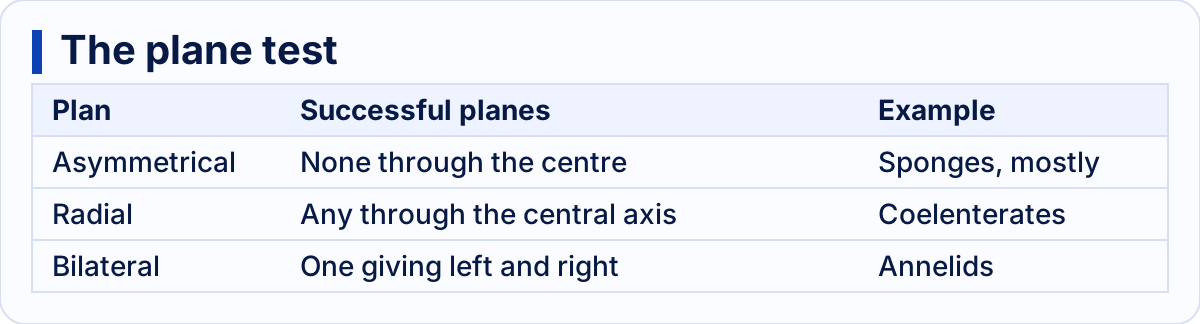
The number of successful cutting planes distinguishes the three symmetry plans.
Use the exact wording of a description. “Any plane through the central axis” points to radial symmetry. “Only one plane gives identical left and right halves” points to bilateral symmetry. General phrases such as “round body” or “balanced appearance” do not settle the test.
Symmetry narrows the possibilities, but it cannot place every animal by itself. The next question moves from visible structure to embryonic construction.
Germ layers establish what the body can be built from
Germ layers are embryonic sheets of cells from which the animal is built. Animals considered here have either two or three.
A diploblastic animal has an external ectoderm and an internal endoderm. Between them lies mesoglea, an undifferentiated layer. Coelenterates provide the example.
A triploblastic animal has a third embryonic layer, the mesoderm, between ectoderm and endoderm. Animals from Platyhelminthes to chordates are triploblastic.
Mesoglea and mesoderm must not be confused. Mesoglea lies between two germ layers but is not itself a germ layer. Mesoderm is a third layer of cells and contributes to structures including muscle, blood and the lining of the body cavity.
Think of the difference as a sandwich with either a spread or a true third layer. The material between the outer layers is present in both cases, but its status is not the same. The analogy helps distinguish the arrangement; the biological test remains whether a mesodermal germ layer exists.

Diploblastic animals have mesoglea; triploblastic animals add mesoderm.
This criterion must come before the coelom question. To decide whether a cavity is lined by mesoderm, you first need to know that mesoderm is present. Yet being triploblastic does not automatically make an animal coelomate. Platyhelminthes has mesoderm but no body cavity.
That distinction leads to the most common classification trap.
A cavity counts as a coelom only when mesoderm lines it
The coelom question has two parts: is there a cavity between the body wall and the gut wall, and if there is, does mesoderm line it?
A coelomate animal has a body cavity lined by mesoderm. Annelids, molluscs, arthropods, echinoderms, hemichordates and chordates belong to this category.
A pseudocoelomate animal has a cavity, but mesoderm does not line it. Instead, the mesoderm occurs as scattered pouches between ectoderm and endoderm. Aschelminthes is the example.
An acoelomate animal has no body cavity between the body wall and gut wall. Platyhelminthes is acoelomate even though it is triploblastic. It has mesoderm; what it lacks is the cavity.
Think of a gap inside a building. Finding space is only the first observation. You must still inspect whether that space has the required lining. In the same way, “body cavity present” leaves two possibilities open: coelomate or pseudocoelomate.

Cavity presence and mesoderm lining together determine coelom type.
Two tempting shortcuts therefore fail:
- “Cavity present, so coelomate” ignores the pseudocoelom.
- “Mesoderm present, so coelomate” ignores the acoelomate condition.
Read for relationships rather than isolated nouns. “Mesoderm,” “cavity” and “lining” may all occur in a description, but their arrangement decides the classification.
Segmentation requires repetition inside and outside
Some animals have bodies divided into a series of segments. True segmentation is not merely a row of visible bands. The division must occur externally and internally, with serial repetition of at least some organs.
In the earthworm, this arrangement is called metameric segmentation, and the phenomenon is metamerism.
Think of a train made from repeated carriages. The outer joins are visible, but each unit also repeats internal features such as doors and seating. Painted stripes on one long carriage would not create a segmented train. Likewise, surface markings alone do not prove animal segmentation.

True segmentation combines outer divisions with repeated internal organs.
When a question mentions serial repetition of organs, it is signalling metamerism. When it mentions only rings, stripes or external bands, the evidence is incomplete. Record segmentation as present only when both the external and internal conditions are supported.
The notochord makes the final major division
The last question asks whether the animal forms a notochord. A notochord is a mesodermally derived, rod-like structure formed on the dorsal side during embryonic development.
Animals that form it are chordates. Animals that do not are non-chordates; the stated non-chordate range runs from porifera to echinoderms.
Four parts of the definition must stay together: mesodermally derived, rod-like, dorsal and embryonic. A rod elsewhere in the body, a ventral structure or something found only in the adult does not satisfy the description.
Think of the notochord as a supporting pole used while a structure is developing. This analogy explains why the decisive clue may come from embryonic development rather than adult appearance. The factual test, however, is the complete four-part definition.

A notochord is identified by origin, shape, position and developmental stage.
This criterion provides a broad final split, but it does not erase the earlier answers. A complete placement still records all six features.
A full description can be solved without the animal’s name
Consider an illustrative animal described as organ-system level, bilaterally symmetrical and triploblastic. It has a cavity between body wall and gut wall, fully lined by mesoderm. Its body is divided externally and internally, some organs repeat serially, and no dorsal rod-like structure forms during embryonic development.
Work in order:
- Cooperating organs establish the organ-system level.
- One plane producing left and right halves establishes bilateral symmetry.
- The presence of mesoderm establishes a triploblastic body.
- The cavity’s mesodermal lining establishes the coelomate condition.
- External and internal divisions with repeated organs establish metameric segmentation.
- Absence of an embryonic dorsal notochord establishes a non-chordate.
Together, those features match an annelid such as an earthworm. The name is the conclusion, not the starting point. If the cavity remained present but the mesoderm occurred as scattered pouches instead of lining it, the coelom classification would change to pseudocoelomate even if the other stated features stayed the same.
That is why memorising names first is fragile: one altered structural relationship can change the placement. A six-entry body-plan record shows exactly which clue did the work.
Key takeaways
- Use the fixed order: organisation, symmetry, germ layers, coelom, segmentation, notochord.
- Test symmetry by the number and position of planes that produce equal halves.
- Keep mesoglea separate from mesoderm; mesoglea is not a germ layer.
- Never infer coelomate from “cavity present” or “mesoderm present” alone.
- Require external and internal divisions plus repeated organs for metameric segmentation.
- Recognise a notochord only when all four clues are present: mesodermal, rod-like, dorsal and embryonic.
- Build the feature profile before attaching a phylum name.
This method settles how to read and organise body-plan clues, not every possible animal identification. Final placement still depends on receiving enough accurate features, and closely related groups may require characteristics beyond these six criteria.