How to Tell Sponges, Cnidarians, Flatworms and Roundworms Apart for NEET
You meet an unnamed animal in a question: it may be asymmetrical, radial or bilateral; it may have two germ layers, three germ layers or no stated germ-layer classification; and its body cavity may be absent, false or simply not applicable. The quickest way to identify it is to read those features as a sequence, not as isolated facts. Among these four groups, symmetry separates sponges first, germ layers separate cnidarians from the worms, and body cavity separates flatworms from roundworms. A diagnostic structure then confirms the answer.
The three criteria form an identification path
Start by giving each criterion one precise job.
Symmetry describes how a body can be divided into comparable halves. A mostly asymmetrical body points toward Porifera, the sponges. Radial symmetry—body parts arranged around a central axis—points toward Cnidaria among the four groups considered here. Bilateral symmetry, with distinct left and right sides, narrows the choice to Platyhelminthes or Aschelminthes.
Germ layers are the embryonic cell layers from which the body develops. Cnidarians are diploblastic, meaning that they have two germ layers. Flatworms and roundworms are triploblastic, meaning that they have three. The chapter does not assign sponges a germ-layer category because they have a cellular level of organisation rather than true tissues.
Body cavity, or coelom, becomes decisive only after you reach the two triploblastic, bilaterally symmetrical groups. Flatworms are acoelomate: they have no body cavity between the body wall and the gut. Roundworms are pseudocoelomate: they have a cavity, but it is not a true coelom lined by mesoderm.
Think of the process as a narrowing corridor. Symmetry opens the correct passage; germ layers take you farther; body cavity settles the final fork.

Symmetry, germ layers and body cavity narrow four phyla to one answer.
This path is powerful, but it should not become a mechanical rule that ignores the rest of the stem. Exam questions often include a diagnostic structure—such as cnidoblasts or flame cells—that identifies the phylum immediately. Use the three criteria to understand and check the answer; use the distinctive structure to confirm it.
Sponges stand apart before germ layers enter the comparison
Porifera are generally marine, mostly asymmetrical animals with a cellular level of organisation. Their cells show some division of labour, but they are not organised into true tissues. That is why trying to force sponges into the diploblastic-versus-triploblastic choice is a mistake: the comparison assumes a tissue organisation that sponges do not possess.
Their defining feature is a canal system. Water enters through minute pores called ostia, passes into the spongocoel, and leaves through the osculum. Choanocytes, or collar cells, line the spongocoel and canals. The same water pathway supports food gathering, respiratory exchange and waste removal, while digestion occurs inside cells.
Example: Suppose a stem describes an animal as mostly asymmetrical and says that water passes through pores into a central cavity. “Mostly asymmetrical” already suggests Porifera. The path from ostia to spongocoel to osculum confirms it. None of those openings is a mouth, and the central cavity is not a coelom.

A sponge uses one water pathway for feeding, gas exchange and waste removal.
The safest identification statement is therefore: mostly asymmetrical + cellular organisation + canal system = Porifera. Examples given in the chapter include Sycon, Spongilla and Euspongia.
The word mostly matters. Treating all sponges as absolutely asymmetrical changes the chapter’s claim and can make an otherwise plausible option wrong.
Cnidarians are radial, diploblastic and built at tissue level
Cnidarians move the organisation grade from cells to true tissues. They are radially symmetrical, diploblastic and at the tissue level of organisation. Their central gastro-vascular cavity has a single opening: the mouth on the hypostome. Digestion is both extracellular and intracellular.
The unmistakable feature is the cnidoblast, also called a cnidocyte. These cells occur on the tentacles and body and contain stinging capsules called nematocysts. They serve in anchorage, defence and capture of prey.
Example: An aquatic animal is described as radially symmetrical and diploblastic, with stinging capsules on its tentacles. Radial symmetry and two germ layers place it at Cnidaria in this four-group comparison; the nematocysts settle the identification.
There is one important wider-chapter trap. Ctenophores are also radial, diploblastic and organised at tissue level. Those three criteria cannot distinguish Cnidaria from Ctenophora. Cnidarians have cnidoblasts with nematocysts, whereas ctenophores have eight external rows of ciliated comb plates.

Shared body-plan traits do not replace the structure that identifies each tissue-level phylum.
Within the requested four groups, the compact rule is radial + diploblastic + cnidoblasts = Cnidaria. Chapter examples include Physalia, Adamsia, Pennatula, Gorgonia and Meandrina. Polyp and medusa forms also belong here, but symmetry and germ layers alone should never override a conflicting diagnostic structure.
Flatworms introduce bilateral symmetry but have no body cavity
Platyhelminthes are the first group here with a clear left and right. They are bilaterally symmetrical, triploblastic and acoelomate, with an organ level of organisation. Their bodies are flattened from the upper surface to the lower surface—described as dorso-ventrally flattened.
“Acoelomate” does not mean that the animal lacks organs or lacks a digestive space. It means there is no body cavity between the body wall and the gut. The organs lie within tissue rather than in a coelomic space.
Think of it as a packed case: the third germ layer is present, but it does not leave an open body cavity around the organs. This is a labelled analogy, not a literal description of tissue arrangement.
Flatworms are mostly endoparasites in animals, including human beings. Parasitic forms may have hooks and suckers, and some absorb nutrients through the body surface. Their flame cells perform both osmoregulation and excretion. Their digestive system has a single opening serving as both mouth and anus, so it is incomplete.
Example: A question gives a bilaterally symmetrical, triploblastic animal with flame cells and no body cavity. Bilateral symmetry rules out sponges and cnidarians. The acoelomate condition points to Platyhelminthes, while flame cells confirm it.

Flatworms combine a flattened bilateral body with organ-level, acoelomate organisation.
The high-yield combination is bilateral + triploblastic + acoelomate + flame cells = Platyhelminthes. Taenia and Fasciola are chapter examples, while Planaria is noted for its high regeneration capacity.
Roundworms share the worm plan but add a pseudocoelom
Aschelminthes, the roundworms, are also bilaterally symmetrical and triploblastic. Those traits cannot separate them from flatworms. The decisive change is that roundworms are pseudocoelomate and reach the organ-system level of organisation.
A pseudocoelom is a body cavity that is not lined by mesoderm. The presence of a cavity does not make the animal coelomate; the lining is the test. This distinction prevents the common error of reading “body cavity” as “true coelom.”
Body shape supplies another clue. Flatworms are dorso-ventrally flattened, whereas roundworms are circular in cross-section. Their alimentary canal is complete, with two openings and a well-developed muscular pharynx. An excretory tube removes waste through an excretory pore.
Example: Consider a bilaterally symmetrical, triploblastic animal with a cavity not lined by mesoderm, a muscular pharynx and a complete alimentary canal. The unlined cavity is a pseudocoelom, so the animal belongs to Aschelminthes. The complete gut confirms the choice.
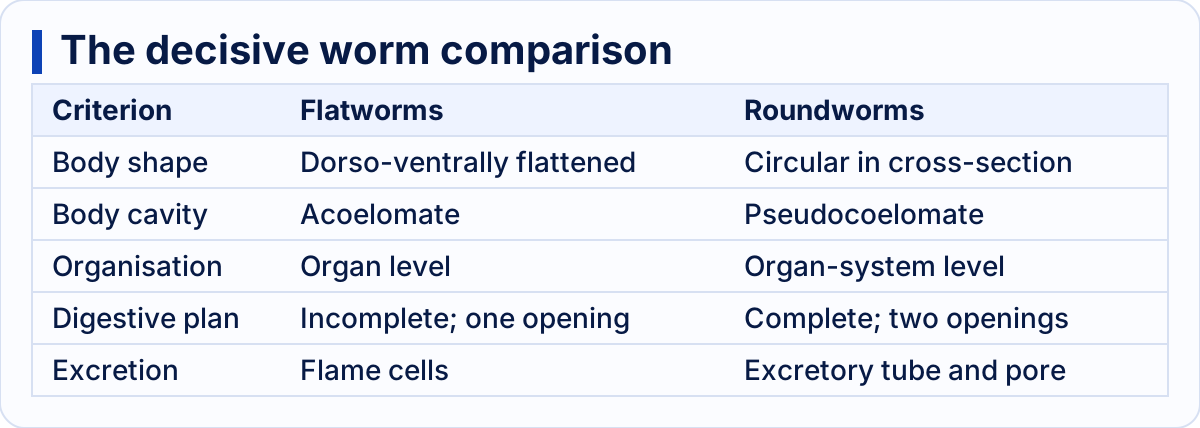
Body cavity and digestive plan separate flatworms from roundworms.
Roundworms also have separate sexes: males and females are distinct, and females are often longer than males. Chapter examples are Ascaris, Wuchereria and Ancylostoma.
The reliable formula is bilateral + triploblastic + pseudocoelomate + complete alimentary canal = Aschelminthes.
A layered check is safer than a single memorised table
A comparison table is useful only if you know how to interrogate it. Begin with the broad body plan, then ask the one question that still separates the remaining options.
| Group | Symmetry | Germ layers | Body cavity | Confirmation | |---|---|---|---|---| | Porifera | Mostly asymmetrical | Not stated | Not stated | Canal system and choanocytes | | Cnidaria | Radial | Diploblastic | Not used to identify it here | Cnidoblasts with nematocysts | | Platyhelminthes | Bilateral | Triploblastic | Acoelomate | Flame cells and flattened body | | Aschelminthes | Bilateral | Triploblastic | Pseudocoelomate | Complete gut and muscular pharynx |
If the animal is mostly asymmetrical, look for sponge plumbing. If it is radial and diploblastic, look for cnidoblasts—and remember the ctenophore trap. If it is bilateral and triploblastic, ask whether the body is acoelomate or pseudocoelomate.
Then confirm rather than restart. A flame cell supports flatworm; an excretory tube supports roundworm. A canal system supports sponge; a nematocyst supports cnidarian.

Each broad body plan leads to one confirming structure.
Key takeaways
- Porifera: mostly asymmetrical, cellular organisation, and a canal system with ostia, spongocoel and osculum.
- Cnidaria: radial, diploblastic and tissue-level, confirmed by cnidoblasts containing nematocysts.
- Platyhelminthes: bilateral, triploblastic and acoelomate, with a flattened body and flame cells.
- Aschelminthes: bilateral, triploblastic and pseudocoelomate, with a complete alimentary canal and muscular pharynx.
- Symmetry separates the broad body plans; germ layers distinguish cnidarians from the worms; body cavity separates flatworms from roundworms.
- A diagnostic structure should confirm the identification, especially where broad criteria are shared.
This framework settles how to distinguish these four phyla using the requested criteria and their supporting structures. It does not classify every radial or bilateral animal: within the wider animal kingdom, the same broad traits can occur in other phyla, so a complete identification still depends on the full set of features supplied in the question.